Wonder That Was Himalayan Art This paper mainly attempts to highlight the Himalayan contribution in the aesthetic expression and artistic creativity which is so enormous but unfortunately until now it has not appropriately been surmised. Throbbing with the naivety and solemnity, Himalayan Art in its medieval epoch reached the soaring heights and prompted many art styles in Central Asia and Tibet. This paper reasonably focuses western Himalayas since it occupies liaison between South Asia and the West, which has strong bearing on the material culture and art. Most of the material evidences supporting the hypothesis have been discovered by the author during his three decades long fieldwork in the remote region. Himalayan Mountains are the icon of India’s glorious entity. High aesthetic concept of Indian society is interwoven with Himalayas. Himalayas are source of naivety; austerity and spirituality from the very outset of Indian civilisation Himalayas have commanded a signifi...
Popular posts from this blog
Some Inscribed Bronze Masterpieces from Western Inner Himalayas: A Stylistic Appraisal
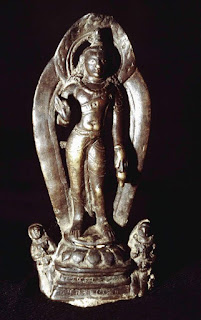
Dialogue April-June 2009 , Volume 10 No. 4 Some Inscribed Bronze Masterpieces from Western Inner Himalayas: A Stylistic Appraisal A.K. Singh This paper is focussed on some selected artworks discovered from the western Trans-Himalayan region, formerly constituent states of Western Tibet (gNari-Khorsum). The paper attempts to present an aesthetic overview on the beginning and burgeoning of a unique artistic culture on Indian periphery which later resulted in to Indo-Tibetan aesthetic expression. Artworks on view and und er discussion were mainly discovered from Upper Sutlej valley (in Tibetan chronicles called Khunu), Ladakh and Zanskar by the author during his more than two decades field work in the region stretching between upper catchments of the rivers Indus and Sutlej. Aesthetically superb in manifestation, artworks under investigation present a very interesting case of diffusion of an art style that is Kashmiri, about which still not much is known. In medieval period...
Comments
Post a Comment